
Introduction: Why the Fate of the Universe Matters (Cosmology & Expansion)
The ultimate fate of the universe is one of the most profound questions in modern cosmology. Scientists study whether the cosmos will continue expanding forever, collapse back on itself, or tear itself apart. These scenarios are known as the Big Freeze, Big Rip, and Big Crunch. Each possibility depends on the behavior of dark energy, matter density, and the overall geometry of space-time.
Understanding the universe’s fate is not just theoretical—it is deeply connected to observations from telescopes, supernova surveys, and cosmic microwave background measurements. Today, cosmologists largely agree that the universe is expanding at an accelerating rate, but the long-term consequences remain uncertain.
📌 Source: NASA – Cosmology Overview
https://science.nasa.gov/universe/overview/
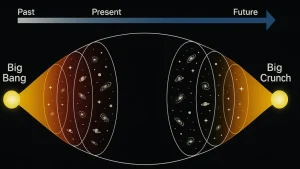
What Determines the Fate of the Universe? (Dark Energy and Expansion)
The destiny of the universe is primarily controlled by three factors:
- The density of matter (ordinary + dark matter)
- The expansion rate of the universe
- The nature of dark energy
Dark energy is the most mysterious component, making up about 68% of the universe. It drives the accelerated expansion discovered in 1998 through observations of distant supernovae. If dark energy remains constant, the universe will expand forever. If it changes over time, completely different outcomes become possible.
The balance between gravity (which pulls matter together) and dark energy (which pushes space apart) determines whether the universe collapses, freezes, or rips apart.
📌 Source: NASA – Dark Energy and Expansion
https://science.nasa.gov/universe/dark-energy/
The Big Freeze (Heat Death of the Universe)
The Big Freeze, also known as the Heat Death of the Universe, is currently considered the most likely scenario by many cosmologists.
In this model, the universe continues expanding forever. Over trillions of years:
- Galaxies drift further apart
- Star formation gradually stops
- Existing stars burn out
- Black holes slowly evaporate via Hawking radiation
Eventually, the universe becomes extremely cold, dark, and dilute. No usable energy remains to support life or thermodynamic processes.
This scenario is based on the assumption that dark energy remains constant (similar to a cosmological constant).
📌 Source: European Space Agency (ESA) – Cosmology Concepts
https://www.esa.int/Science_Exploration/Space_Science/Cosmology
The Big Rip: When Dark Energy Tears the Universe Apart
The Big Rip is a more dramatic and less likely possibility. It occurs if dark energy becomes stronger over time.
In this scenario:
- First, galaxy clusters are pulled apart
- Then galaxies, solar systems, and planets disintegrate
- Eventually, even atoms are torn apart as space-time itself is stretched infinitely
This idea depends on a hypothetical form of dark energy called phantom energy, where its equation of state causes expansion to accelerate without limit.
While current observations do not strongly support phantom energy, it remains a theoretical possibility.
📌 Source: Caldwell et al., Physical Review Letters (2003) – Phantom Energy and Cosmic Doomsday
https://journals.aps.org/prl/abstract/10.1103/PhysRevLett.91.071301
The Big Crunch: The Universe Collapses Back
The Big Crunch represents the opposite of expansion. Instead of accelerating outward, the universe eventually slows down and reverses, collapsing under gravity.
In this model:
- Expansion stops
- Galaxies begin moving toward each other
- Temperatures rise as density increases
- The universe ends in a hot, dense singularity
This scenario would require the density of matter and energy to be high enough to overcome expansion. However, current measurements suggest the universe is too low in density for a Big Crunch to occur.
📌 Source: Stanford Encyclopedia of Philosophy – Cosmology and the Fate of the Universe
https://plato.stanford.edu/entries/cosmology/
Current Scientific Evidence: What Do Observations Show?
Modern observations strongly support an accelerating universe, primarily based on:
- Type Ia supernova observations
- Cosmic Microwave Background (CMB) data
- Large-scale galaxy distribution surveys
The Planck satellite measurements indicate that the universe is geometrically flat and dominated by dark energy consistent with a cosmological constant. This significantly reduces the likelihood of a Big Crunch and makes eternal expansion more probable.
📌 Source: Planck Collaboration (ESA) – Cosmological Parameters
https://www.cosmos.esa.int/web/planck
Which Scenario Is Most Likely? (Big Freeze Dominance)
Based on current data, the Big Freeze is considered the most scientifically supported outcome. The reasoning is:
- Dark energy appears constant (not increasing or decreasing significantly)
- Expansion is accelerating, not slowing
- Matter density is too low to reverse expansion
However, cosmology is still evolving. New physics—such as evolving dark energy models or quantum gravity effects—could change this conclusion in the future.
The Big Rip remains speculative, while the Big Crunch is increasingly unlikely under current models.
📌 Source: NASA – Fate of the Universe
https://science.nasa.gov/universe/fate/
SEO Keywords: Universe Fate, Big Freeze, Big Rip, Big Crunch Explained
To understand the ultimate fate of the universe, scientists combine observational astronomy with theoretical physics. Terms like cosmic expansion, dark energy theory, and heat death of the universe are central to ongoing research in cosmology.
These models help researchers explore not only how the universe began (Big Bang), but also how it might end.
Conclusion: The Universe’s End Remains an Open Scientific Question
The ultimate fate of the universe depends on the unknown nature of dark energy. While current evidence favors a Big Freeze scenario, science has not yet reached a final answer.
Future missions, such as advanced space telescopes and dark energy surveys, may refine or even completely revise our understanding of cosmic destiny. For now, the universe appears to be heading toward an ever-expanding, cooling future—but cosmology continues to evolve.
📌 Source: NASA – Universe Evolution
https://science.nasa.gov/universe/overview/